
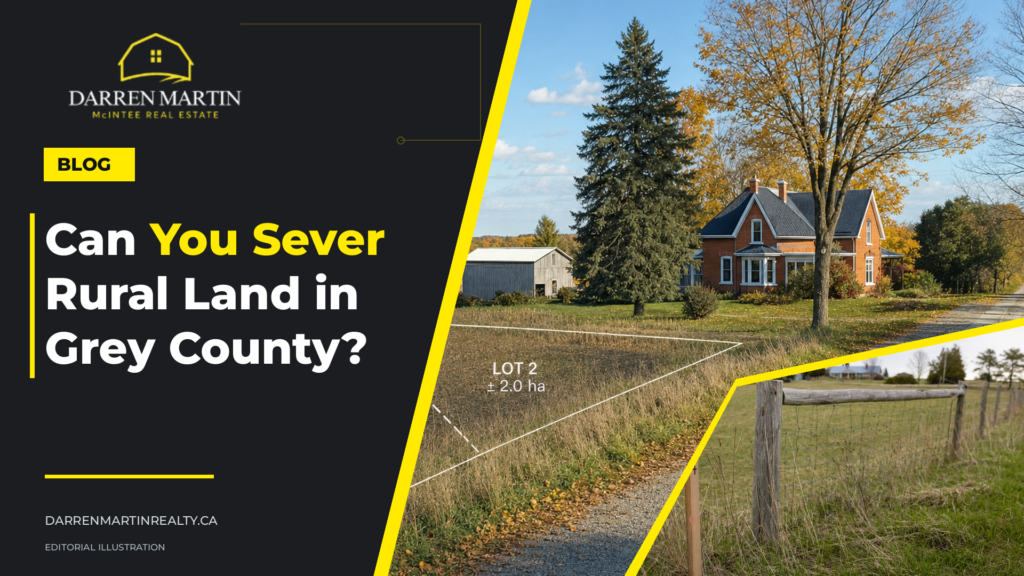
Possibly, but you should not assume that a rural property can be divided because it is large. In Ontario, creating a new parcel usually requires municipal approval through a land severance, also called a consent. The approval authority considers the proposal’s conformity with the official plan and zoning, the suitability of the proposed lots, access, water supply, sewage disposal and protection from potential flooding. Ontario’s consent guidance explains that the answer depends on the specific land and the applicable planning framework.
That means a listing’s acreage is not proof that a second building lot can be created. Before making an offer on a farm, acreage, vacant parcel or country property in Grey County, treat severance potential as something to investigate-not as an included feature.
What does severing rural land mean?
A severance is the authorized separation of part of a property to create a new lot or parcel. Consent may also be relevant to certain lot additions, easements and other changes to property boundaries. The approval comes from the applicable consent-granting authority; a private agreement between a buyer and seller does not create a new legal parcel.
If more than one or two lots are contemplated, the municipality may determine that a plan of subdivision is the more appropriate planning process. Ask the municipality which application applies before relying on a proposed lot layout.
Six questions to answer before relying on a future severance
1. Does the official plan and zoning support the proposal?
Begin with the property’s official plan designation and zoning. These documents may regulate permitted uses, minimum lot dimensions, setbacks, building locations, access and other development standards. Agricultural, rural, environmental and settlement-area policies can produce very different results.
Ontario’s zoning guidance explains that zoning bylaws control how land may be used and developed. Ask the applicable municipality for property-specific confirmation rather than relying on a listing description or an informal statement that the land is “severable.”
2. What is the parcel’s planning and title history?
Previous consents, lot additions, retained parcels, subdivision approvals and other planning applications may affect the proposal. The original parcel configuration and prior land division history can matter even when the current property appears large enough to split.
Request available planning records and have a real estate lawyer review the legal description, title, survey information and registered instruments. A seller’s belief that “there should be another severance” is not approval.
3. Would the proposed lot have acceptable access?
A line on a sketch is not enough. Confirm whether the proposed lot would have frontage on a suitable public road or another form of access accepted by the municipality. Review registered easements, road maintenance, driveway location, sightlines and emergency access where relevant.
Also identify who would be responsible for constructing and maintaining a driveway, clearing snow and resolving any shared-access issues. These details can affect both the feasibility and the cost of the proposal.
4. Can the proposed lot support water and sewage systems?
Many rural properties rely on a private well and an onsite sewage system. A proposed lot needs enough suitable area for the dwelling, driveway, well and sewage system while meeting applicable setbacks and site requirements.
Do not infer buildability from the size of the parcel alone. Ask the municipality and the relevant building or septic authority what information is required, and obtain property-specific advice from qualified professionals where the proposal depends on soil, drainage or a particular building envelope.
5. Are there physical or environmental constraints?
Wetlands, flood-prone areas, watercourses, steep slopes, poor drainage, woodlands, conservation restrictions and other site conditions may affect where a lot can be created or built on. Agricultural policies may also affect the amount or location of land proposed for separation.
Ontario’s consent process specifically considers the suitability of the land, water supply, sewage disposal and protection from potential flooding. A pleasant homesite viewed from the road is not enough to establish that a consent or building permit will be available.
6. What happens if approval is refused or comes with conditions?
A consent application may receive provisional approval with conditions rather than an unconditional green light. Conditions can include matters such as a road widening, parkland dedication, rezoning, a minor variance, an agreement with the municipality or other required approvals. Ontario states that conditions must be satisfied before the certificate is issued and the severance takes effect.
If your purchase decision depends on a future lot, discuss the risk with your REALTOR® and lawyer before submitting an offer. The agreement may need carefully drafted conditions for planning information, feasibility, financing, surveys, servicing or an application outcome. Do not waive a condition simply because the land looks suitable.
What should you request before making an offer?
Organize the review around the proposed lot, not just the entire property. Depending on the land and your intended use, request or investigate:
- Official plan designation and current zoning
- Previous consent, subdivision, lot-addition and minor-variance decisions
- Survey plans, legal descriptions and parcel history
- Road frontage, registered access and easements
- Well records, water information and septic records, where applicable
- Floodplain, wetland, drainage and conservation information
- Existing leases, farm arrangements or agreements affecting the land
- Municipal comments on the proposed lot configuration and intended use
Where possible, ask planning questions in writing and keep the response with the property file. Share the information with your lawyer and any planner, surveyor, septic professional, engineer or other specialist whose advice is needed.
How should severance potential affect the price you pay?
Value the property according to what is confirmed today. Land with an approved and completed severance is different from land that merely appears capable of being divided. The same caution applies to claims about a second home, an additional building lot, a rental unit or another future use.
If the property only works financially if a severance is approved, compare it with alternatives that already meet your needs. This can help you avoid paying a premium for planning potential that may not be available.
How Darren Martin Realty can help
Darren Martin Realty works with buyers and sellers of rural and country properties, acreages, farms, agricultural real estate and vacant land throughout West Grey, Grey County, Bruce County, North Wellington and surrounding communities. The firm’s public guidance identifies zoning, access, services and intended use as matters to assess, while stating that property-specific zoning, severance, building and development questions should be confirmed with the applicable municipality and qualified professionals.
For broader rural-property checks, see Darren Martin Realty’s Grey County rural-property due-diligence guide. If you are considering a property whose value depends on a future severance, contact Darren Martin before making an offer to discuss your intended use and the questions that should be addressed first.
Final takeaway
You may be able to sever rural land in Grey County, but acreage alone does not establish that a new lot can be created. Confirm the planning framework, parcel history, access, water and sewage options, physical constraints and offer conditions before relying on future severance potential.
This article is general information only. It is not legal, planning, engineering, septic, environmental, tax or financial advice. Confirm property-specific requirements with the applicable municipality and qualified professionals before making or firming up an offer.