
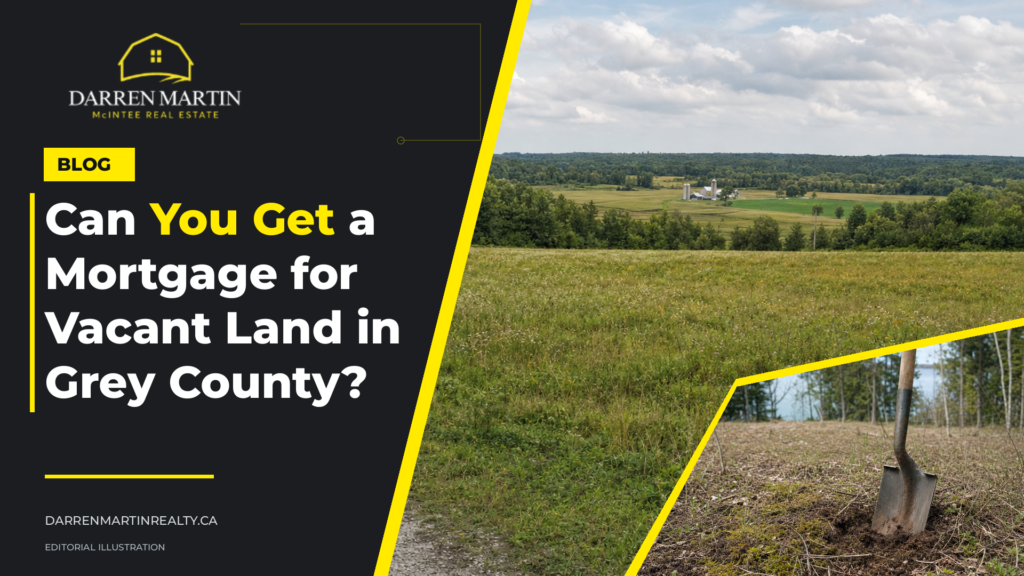
Yes, vacant land in Grey County may be financeable, but a land-only purchase is not assessed exactly like a conventional home purchase. The available financing, required equity and lender conditions depend on the property, your intended use, your financial circumstances and the lender’s own criteria.
Before making an offer, speak with a lender or qualified mortgage professional about the specific parcel. At the same time, confirm what the land can legally and practically support. A financing conversation is much more useful when you can provide the property’s zoning, access, servicing information and a realistic plan for its use.
Why financing vacant land can be different
Vacant land does not have an existing dwelling to assess, occupy or use as part of the lender’s security. Rural parcels may also have fewer directly comparable sales, no rental income and conditions that affect future use or resale.
The uncertainty is greater when the land is unserviced or when your plans depend on approvals that have not yet been obtained. A parcel may look affordable while still requiring substantial investigation into access, water, sewage, electricity, building permissions and other site conditions.
Ontario guidance says rural servicing may involve a private well and an on-site sewage system where municipal water and sewage are unavailable. It also advises buyers to confirm local requirements with the municipal planning and building departments. Ontario’s rural servicing guidance is a useful starting point, not a property-specific approval.
What to discuss with a lender
There is no single vacant-land mortgage rule that applies to every parcel. Ask how the lender would assess the specific property and what documents or conditions would be required.
- Intended use: Explain whether you plan to build a primary residence, hold the land, farm it, use it recreationally or pursue another use that must be permitted.
- Property characteristics: Provide the legal description, lot size, road access, current use, zoning information and any available survey or planning documents.
- Equity and reserves: Ask what funds may be required for the purchase and what cash reserves you should retain for taxes, insurance, legal work, reports and early site expenses.
- Construction plans: If you intend to build, ask what level of detail the lender expects about timing, approvals, budget and the transition from land purchase to construction financing. Do not assume that a future construction plan will automatically change the terms of the land purchase.
- Property-specific conditions: Confirm whether an appraisal, legal review, survey, planning confirmation or other report will be required before closing.
A pre-qualification for a house is not confirmation that the same lender will finance an unserviced parcel. Get the answer for the land you are actually considering, and make sure your offer includes appropriate financing and professional-review conditions.
Check zoning and permitted use before relying on the financing plan
Grey County’s planning resources explain that zoning by-laws are the responsibility of the local municipality, not the County as a single zoning authority. The County provides planning information and a GIS map, but property-specific zoning and approvals should be confirmed with the municipality where the land is located. See Grey County’s land-use planning FAQ and its land-use planning resources.
Check whether your proposed use is permitted under the current zoning and Official Plan framework. If your plan depends on a new lot, a zoning change, a minor variance, a severance or another approval, treat that approval as unresolved until the appropriate authority confirms it.
Ontario explains that changing land use or creating new lots generally requires an application to the appropriate decision-maker. That process can involve conformity with the Official Plan, consistency with the Provincial Planning Statement and other site-specific considerations. Read Ontario’s guide to applying for land-use changes before assuming that a preferred future use is available.
Due diligence that can affect the purchase
These checks do not guarantee financing, but they can help you identify problems before you commit to a parcel.
Access and road maintenance
Confirm the legal access shown in the title documents and determine how the road is maintained. A publicly maintained road, private road, shared lane and registered right-of-way can create different practical questions for a buyer, lender and insurer.
Water and sewage servicing
Ask what information exists about municipal connections, well records, groundwater, soils, drainage and septic suitability. Nearby wells or neighbouring septic systems are not proof that your proposed building site will support the same arrangement.
Ontario’s well guidance identifies factors such as geology, groundwater conditions and the location of existing or planned septic systems when selecting a well site. This is why a servicing question should be investigated on the property itself rather than inferred from a listing description or a nearby parcel.
Natural and planning constraints
Review wetlands, flood-prone areas, steep slopes, conservation restrictions, natural heritage features, aggregate resources, easements and other limitations. These issues may reduce the usable portion of the land or affect what approvals are needed.
Costs beyond the purchase price
Prepare a preliminary budget for property taxes, insurance, legal fees, surveys, planning work, driveway construction, hydro extensions, well and septic investigations, permits and professional reports. The amounts will vary by property, so use estimates from appropriate providers rather than assuming a standard rural allowance.
Questions to answer before making an offer
- Has a lender or mortgage professional reviewed this specific vacant parcel?
- What equity, reserves and documentation may be required?
- Is the intended use permitted under the current municipal zoning?
- Is there legal and practical access throughout the year?
- What evidence supports the proposed water and sewage solution?
- Are there surveys, planning records, well records or environmental reports available?
- Which conditions should address financing, title, planning, access, water, sewage and other property-specific concerns?
- If construction is planned, what approvals, budget and timing must be confirmed before relying on that plan?
How Darren Martin Realty can help
Vacant-land decisions involve more than price per acre. The fit depends on the land’s location, access, services, permitted use and the amount of planning and construction work you are prepared to undertake.
Darren Martin Realty works with buyers and sellers of vacant and rural land, farms, acreages and country properties throughout West Grey, Grey County, Bruce County, North Wellington and surrounding communities. You can review the rural real estate services or contact Darren about a vacant-land purchase before writing an offer.
Important: This article provides general information, not mortgage, legal, planning, engineering, environmental, septic or financial advice. Confirm financing with your lender or mortgage professional, and verify property-specific questions with the municipality and appropriate qualified professionals.