
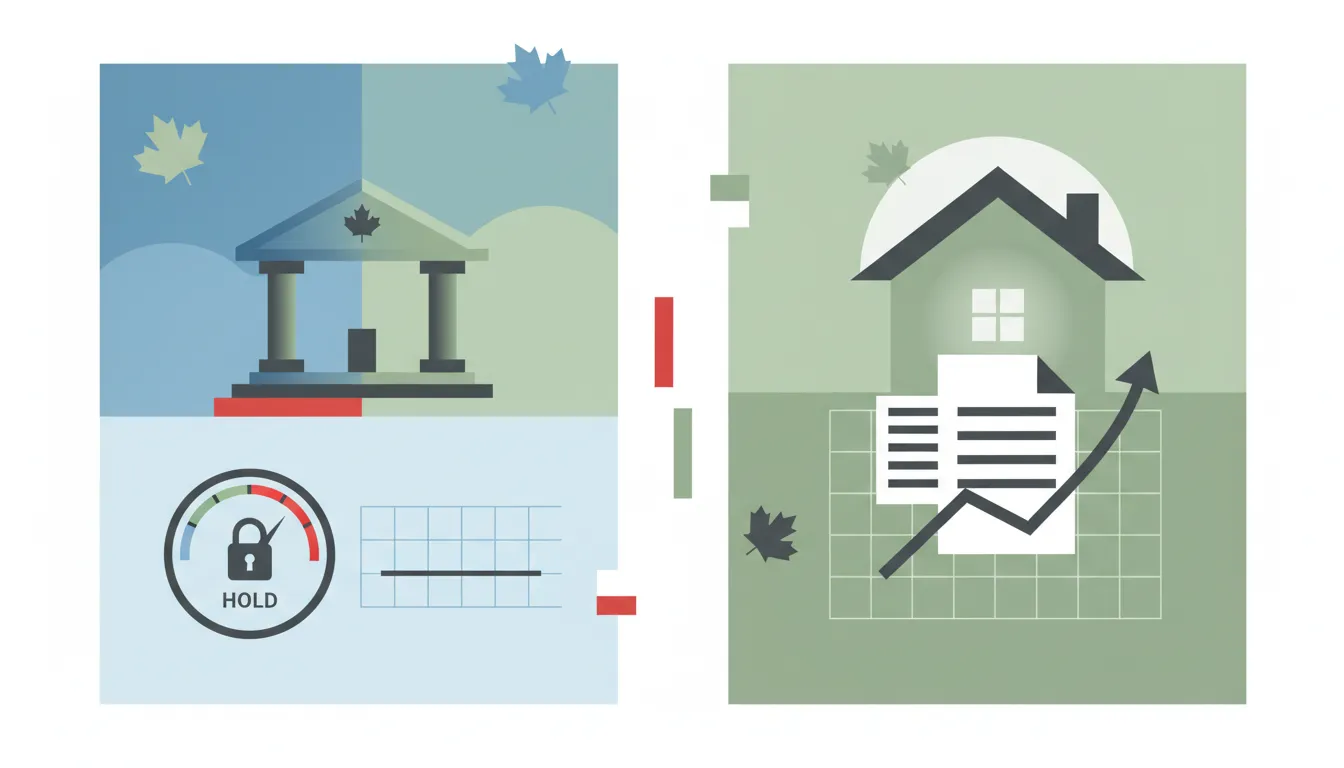
If the Bank of Canada leaves its policy rate unchanged, many borrowers assume mortgage rates should stay flat too. That is not always how it works.
In Canada, variable mortgage rates and fixed mortgage rates are driven by different forces. So even during a Bank of Canada rate hold, your fixed mortgage rate can still move higher. That matters for home buyers, homeowners nearing renewal, and anyone deciding between fixed and variable right now.
This guide explains why that happens, what it means for the current market, and how to think through your next mortgage decision.
Short answer: a Bank of Canada hold does not control fixed mortgage rates
The key point is simple:
- Variable mortgage rates are tied much more closely to the Bank of Canada and lender prime rates.
- Fixed mortgage rates are driven mainly by bond yields, especially the 5-year Government of Canada bond yield for 5-year fixed mortgages.
That means fixed mortgage rates can rise even when the Bank of Canada does nothing. If bond yields climb, lenders may raise fixed mortgage pricing anyway.
This is why headlines about a rate hold can be misleading for people who are actually buying, refinancing, or renewing a mortgage.
How fixed mortgage rates are set in Canada
For many borrowers, the missing piece is the bond market.
A common rule of thumb is that a 5-year fixed mortgage rate moves with the 5-year government bond yield, plus the lender’s spread for funding costs, risk, and profit. The exact pricing is not fixed by formula, but when bond yields rise, fixed mortgage rates often rise too.
That is why lenders can increase fixed rates even if the overnight rate stays the same.
Why bond yields move
Bond yields react to market expectations, including:
- Inflation risk
- Economic uncertainty
- Employment trends
- Global market volatility
- Geopolitical conflict
When markets expect more inflation or more uncertainty ahead, bond yields can rise. And when yields rise, fixed mortgage rates often follow.
Why fixed mortgage rates have been moving up
Recent pricing has shown this clearly. Even with the Bank of Canada holding rates, fixed mortgage rates have moved up from the high 3% range to the low 4% range in a relatively short period.
The reason is not the overnight rate. The reason is that bond markets have repriced risk.
One factor discussed heavily in the market is geopolitical tension in the Middle East, which has contributed to volatility and higher bond yields. If lenders see their own funding costs rising or expect more inflation pressure, they adjust fixed mortgage rates upward.
So when people say, “The Bank of Canada held rates, so mortgages should be stable,” that only tells part of the story.
Variable vs fixed mortgage rates: why the difference matters
Understanding the difference between fixed and variable is essential, especially in a volatile market.
Variable-rate mortgages
Variable rates usually move with lender prime rates, which are heavily influenced by the Bank of Canada’s policy rate.
If the Bank of Canada cuts rates, variable mortgages may become cheaper. If it hikes, variable rates usually rise.
Fixed-rate mortgages
Fixed rates are shaped more by bond yields and market expectations. They can rise before the Bank of Canada moves, or even rise while the central bank stands still.
This is why the bond market is often described as being “ahead” of central banks. It reflects where investors think inflation, growth, and rates may be heading.
Why many borrowers are choosing fixed right now
In calmer periods, variable mortgages can look attractive when borrowers expect rate cuts. That helps explain why variable demand had increased earlier as many expected lower rates ahead.
But when uncertainty rises, preferences can change quickly.
Current borrower behavior shows a shift toward 3-year fixed and, to a lesser extent, 5-year fixed. The main reason is risk control. Many borrowers are less interested in chasing the lowest possible rate and more interested in limiting payment shock.
That shift makes sense in an environment where:
- Fixed and variable pricing is relatively close
- There is concern about future inflation
- There is concern that the Bank of Canada may not cut as quickly as once expected
- Borrowers remember how fast variable payments rose in the last cycle
The spread between fixed and variable has recently been discussed in the range of roughly 0.5% to 0.7%. That is meaningful, but not so wide that borrowers automatically choose variable. For many households, the peace of mind of a fixed payment is worth the premium.
What happened in 2022, and why it still matters
A major reason borrowers are cautious today is what happened when rates surged in 2022.
Many buyers previously chose variable mortgages because they offered the lowest rate and helped them qualify under the mortgage stress test. At the time, that decision looked sensible on paper.
But when rates jumped quickly, those borrowers were exposed to a much larger increase in borrowing costs than people who had locked into fixed terms earlier.
The lesson many households took from that period was not that variable is always bad. It was that the cheapest option upfront can carry the biggest downside if conditions change fast.
That memory still affects decision-making today. When economic and geopolitical risk feels elevated, more borrowers prioritize certainty over potential savings.
Why this matters so much for mortgage renewals in 2026
The next big issue is renewals.
2026 is shaping up to be a major mortgage renewal year, with large groups of borrowers rolling over from both:
- 2021 mortgages, when rates were very low
- 2023 mortgages, when rates were much higher
Those two groups face very different realities.
Borrowers renewing from 2021
Homeowners coming off very low pandemic-era fixed rates may see a significant jump in payments at renewal if they move into the current rate environment.
For this group, even a “normal” rate around 4% can feel like a major affordability shock.
Borrowers renewing from 2023
Some borrowers who locked in shorter terms at higher rates in 2023 may actually see relief if current rates are below what they previously signed for.
So the renewal story is not the same for everyone. It depends heavily on when the original mortgage was taken and what type of term was chosen.
Why rate holds matter for spring and summer buyers
Another underappreciated issue is the role of rate holds.
Many buyers secure a mortgage rate hold for roughly 90 to 120 days. That can protect them from rising rates for a limited time while they shop for a property.
For buyers who locked rates earlier when fixed pricing was lower, those holds may still make a purchase feasible. But once the hold expires, the new rate may be noticeably higher.
That can affect the market in two ways:
- Some buyers rush to buy before the hold expires
- Others step back entirely if the new payment no longer works
This can have a real effect on seasonal market activity, especially when buyers are highly payment-sensitive.
Why a Bank of Canada hold can create false confidence
Rate-hold headlines often create the impression that conditions are stable. But for people dealing with fixed mortgage pricing, that confidence can be misplaced.
If bond yields are rising, then borrowing costs for many borrowers are still worsening, even without a formal central bank move.
That matters because today’s housing market is especially sensitive to financing costs. End-user buyers often base decisions on monthly affordability, not just home price. A move from the high 3% range to the low 4% range can meaningfully change what a household can afford.
So a central bank hold may calm sentiment at the headline level while affordability worsens underneath.
How to think about fixed vs variable right now
There is no one-size-fits-all answer, but there is a practical way to evaluate the decision.
Choose fixed if your priority is payment certainty
A fixed mortgage may suit you if:
- You want predictable payments
- You have little room in your budget for surprises
- You are worried about inflation or future rate hikes
- You value downside protection more than potential savings
This is why many borrowers are leaning toward 3-year or 5-year fixed terms in the current environment.
Choose variable if you can handle volatility
A variable mortgage may still appeal if:
- You believe rates are likely to fall over your term
- You can absorb payment changes or have a financial buffer
- You are comfortable with uncertainty
- You understand that lower initial pricing may not stay lower
The right choice depends less on predicting markets perfectly and more on your ability to live with the downside if you are wrong.
A simple framework for deciding between fixed and variable
Before choosing, ask these five questions:
- How tight is your monthly budget?
If higher payments would create real stress, fixed may be safer. - How long do you expect to keep the mortgage?
A shorter or longer expected holding period can affect which term makes more sense. - Are you buying, renewing, or refinancing?
Each situation has different trade-offs and urgency. - Do you already have a rate hold?
If yes, know exactly when it expires and what happens after. - Are you choosing based on the lowest rate alone?
The best mortgage is not always the cheapest headline rate.
Common mistakes borrowers make when rates are volatile
1. Assuming all mortgage rates follow the Bank of Canada
This is the biggest misconception. Variable and fixed rates do not move the same way.
2. Chasing the lowest rate without considering risk
A lower variable rate can be tempting, but the real question is whether the savings justify the potential downside.
3. Ignoring the bond market
If you are considering a fixed mortgage, bond yields matter. Waiting for a Bank of Canada announcement alone may not tell you where fixed pricing is heading.
4. Letting a rate hold expire without a plan
If you are shopping with a rate hold, track the expiry date closely. A small change in rate can change affordability and qualification.
5. Treating all renewals the same
Someone renewing from a 2021 ultra-low rate faces a different problem than someone renewing from a higher 2023 rate.
What this means for the Canadian housing market
Mortgage pricing affects demand directly. In a market where buyers are sensitive to borrowing costs, rising fixed rates can cool activity even if the Bank of Canada is on hold.
That is especially important in markets where affordability is already stretched. If fixed rates drift higher and rate holds expire, some buyers may pause their plans. Others may lower their budget or switch property types.
Renewal pressure adds another layer. Households facing payment increases may reduce spending, delay moving, or make more conservative housing decisions.
In other words, mortgage rates influence far more than just individual loan choices. They shape overall market behavior.
Frequently asked questions
Can fixed mortgage rates go up if the Bank of Canada holds rates?
Yes. Fixed mortgage rates are largely influenced by bond yields, not just the Bank of Canada’s policy rate.
What affects a 5-year fixed mortgage rate in Canada?
The 5-year Government of Canada bond yield is a major driver, along with lender funding costs and market risk.
Why are borrowers moving from variable to fixed?
Many want protection from future rate volatility, especially after the rapid rate increases seen in the last cycle.
Is fixed better than variable right now?
Not universally. Fixed offers certainty, while variable may offer savings if rates fall. The better option depends on your budget, risk tolerance, and timing.
What is the mortgage renewal cliff?
It refers to a large wave of mortgages renewing around the same period, including many borrowers coming off very low pandemic-era rates and others renewing from higher-rate vintages.
Bottom line
If your mortgage rate is rising even though the Bank of Canada held rates, that does not mean something is broken. It means you are likely looking at the part of the market driven by bond yields, not the overnight rate.
For borrowers, the practical takeaway is clear:
- Do not rely on Bank of Canada headlines alone
- Understand whether you are exposed to fixed-rate or variable-rate pricing
- Know when your rate hold expires
- Choose a mortgage based on risk, not just the lowest advertised rate
In a volatile environment, the most important question is not just where rates are today. It is how much uncertainty your finances can absorb if conditions change.