
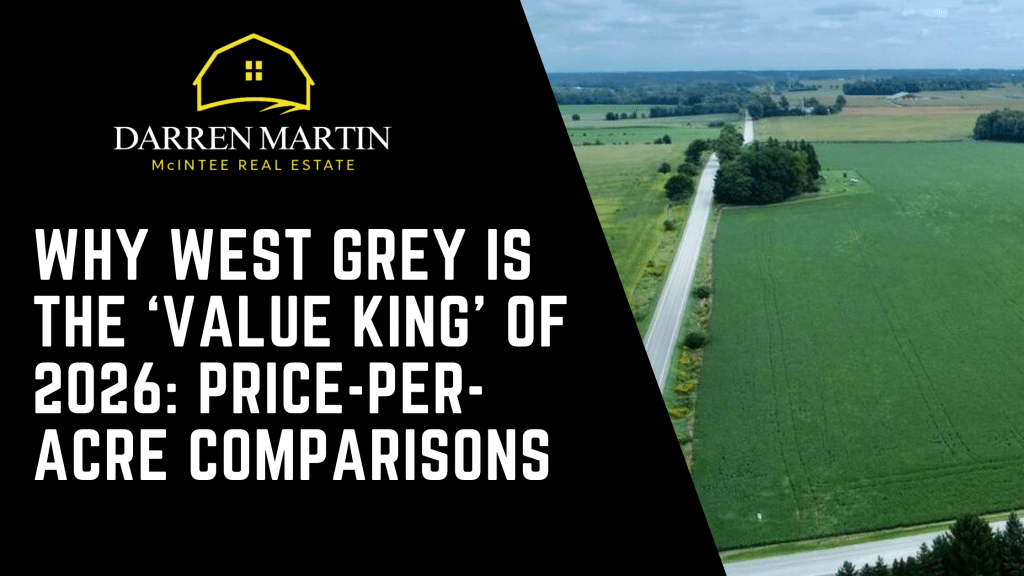
West Grey stands out as 2026’s value king because you get more usable acres for your money than in Wellington County, Caledon, Erin, Halton Hills, Uxbridge, or the Blue Mountains.
You can often afford larger parcels with space for hobby farming, recreation, or a custom build, without sacrificing privacy or practical access to town services.
Prices stay lower partly because the area gets less hype, not because demand is weak. There’s more behind that advantage.
Key Takeaways
- West Grey offers lower price-per-acre than Wellington County, Caledon, Erin, Halton Hills, Uxbridge, and rural Durham.
- Buyers typically get larger, more usable parcels in West Grey for the same budget spent in higher-priced rural markets.
- West Grey’s pricing stays lower because it attracts less speculation and fewer bidding wars than trendier neighboring areas.
- The area delivers strong lifestyle value with privacy, hobby farm potential, recreation space, and access to small-town essentials.
- In 2026, affordability pressures make West Grey a smart long-term land play with upside as more buyers recognize its value.
How Do West Grey Land Prices Compare?
You also get a comparison story that looks strong on value, not just sticker price.
In West Grey, your dollars can translate into larger parcels, better flexibility for hobby farming or recreation, and less pressure to compromise on features.
When you compare listings by acreage, not just total price, West Grey tends to stand out as practical, attainable, and easier to justify for buyers focused on land utility and long-term upside.
Which Markets Cost More Than West Grey?
That value gap becomes even clearer when you line West Grey up against higher-priced rural markets across Southern Ontario.
You’ll usually see steeper per-acre numbers in Wellington County, Caledon, Erin, Mono, and parts of Northumberland and Prince Edward County. Those areas attract buyers who can pay a premium for proximity to major employment centres, recreation, and established country-home demand.
You’ll also find stronger pricing in pockets of Halton Hills, Uxbridge, and rural Durham, where land competes with commuter-oriented demand and limited supply.
Even farther north, select parcels near Collingwood, Creemore, and the Blue Mountains often trade above West Grey because lifestyle-driven buyers actively chase acreage there.
When you compare those markets side by side, West Grey stands out as one of the more affordable options for buyers who still want meaningful acreage in Southern Ontario today.
Why Might West Grey Land Be Undervalued?
Although West Grey offers the same core appeal many rural buyers want—space, privacy, workable land, and small-town access—it often sells at a discount because it hasn’t attracted the same level of speculative attention as better-known country markets.
You’re seeing a pricing gap created by perception, not necessarily fundamentals.
| Factor | Why it depresses pricing |
|---|---|
| Lower profile | Fewer headline-driven buyers compete |
| Less speculation | Investors haven’t bid values up |
| Nearby comparisons | Buyers chase trendier neighbouring areas |
| Slower buzz cycle | Recognition lags behind actual demand |
If you watch rural markets closely, you’ll notice value often hides where branding is weaker. West Grey doesn’t dominate conversations, so prices can stay softer longer. That gives you a window before broader buyer awareness catches up and narrows the discount.
What Do Buyers Get With West Grey Land?
In practical terms, buyers get three things with West Grey land: usable space, everyday privacy, and flexibility. You’re not paying for a narrow lot or a cramped setting. You get room for a home, outbuildings, gardens, trails, or hobby uses that need real ground to work.
You also get separation from neighbours without feeling isolated from essentials. That changes how the property feels day to day. You can enjoy quieter mornings, clearer views, less road noise, and more control over how your space functions.
Just as important, West Grey land gives you options. Some parcels suit custom builds. Others fit recreational use, small-scale agricultural activity, or long-term family plans.
If you want land that can match your lifestyle instead of limiting it, that practical flexibility matters.
Is West Grey a Smart Land Buy in 2026?
Those practical benefits are exactly why many buyers see West Grey as a smart land buy in 2026. You get more acreage for your budget, but you also gain flexibility.
Whether you want a future home site, hobby farm, or long-term hold, West Grey gives you room to act. You aren’t paying premium prices just to secure space, and that lowers your risk while preserving upside.
- Lower entry costs than many nearby rural markets
- Larger parcels that support varied residential or agricultural uses
- Growing buyer interest as affordability pressures spread outward
- Practical access to small-town services, highways, and regional job centres
- Strong lifestyle appeal for families, retirees, and investors alike
If you want value, usability, and future potential in one purchase, West Grey deserves serious attention in 2026.
Frequently Asked Questions
What Zoning Restrictions Commonly Affect Rural Land Purchases in West Grey?
You’ll commonly face agricultural, environmental, and rural residential zoning limits in West Grey.
They can restrict building size, setbacks, severances, livestock uses, home businesses, driveway access, and development near wetlands, floodplains, or conservation areas.
Are There Financing Options Specifically for Vacant Land Buyers?
Yes, you can use vacant land loans, farm credit, seller financing, or home-equity funds. You’ll usually need 20–50% down, stronger credit, and a clear development plan. Compare local lenders, rates, terms, and closing costs carefully.
How Do Property Taxes in West Grey Compare With Neighboring Municipalities?
You’ll generally find West Grey’s property taxes competitive and often lower than nearby municipalities, especially on comparable rural parcels. You should still compare each township’s mill rate, assessment, and service levels, because those directly affect annual costs.
What Environmental Assessments Should Buyers Request Before Purchasing Acreage?
Request a Phase I ESA, wetland and floodplain mapping, well-water testing, septic inspection, soil and drainage analysis, and species-at-risk screening. You’ll also want past land-use records, contamination reports, and nearby aggregate or industrial activity.
Are There Upcoming Infrastructure Projects That Could Influence Land Accessibility?
Yes—you should watch planned road resurfacing, bridge repairs, broadband expansion, and utility upgrades, because they can improve year-round access and raise land appeal.
Check municipal capital plans, county transportation schedules, and provincial infrastructure announcements regularly.
Conclusion
If you’re comparing Ontario land in 2026, West Grey stands out for one simple reason: you get more for your money. You’ll often pay less per acre here than in hotter nearby markets, while still getting space, versatility, and long-term upside.
That mix makes West Grey feel undervalued today. If you want land that balances affordability with future potential, you shouldn’t overlook it. For many buyers, West Grey may be the value king this year.